CVE-2026-98432 Explained: The Linux TCP Bug Every Render Node Should Patch
CVE-2026-98432 is a 9.8 Critical use-after-free in the Linux IPv4 TCP handshake, reachable without a login. Here is how it works, why MPTCP and Go matter, how to check your render nodes, and the fixed kernel versions per distro.
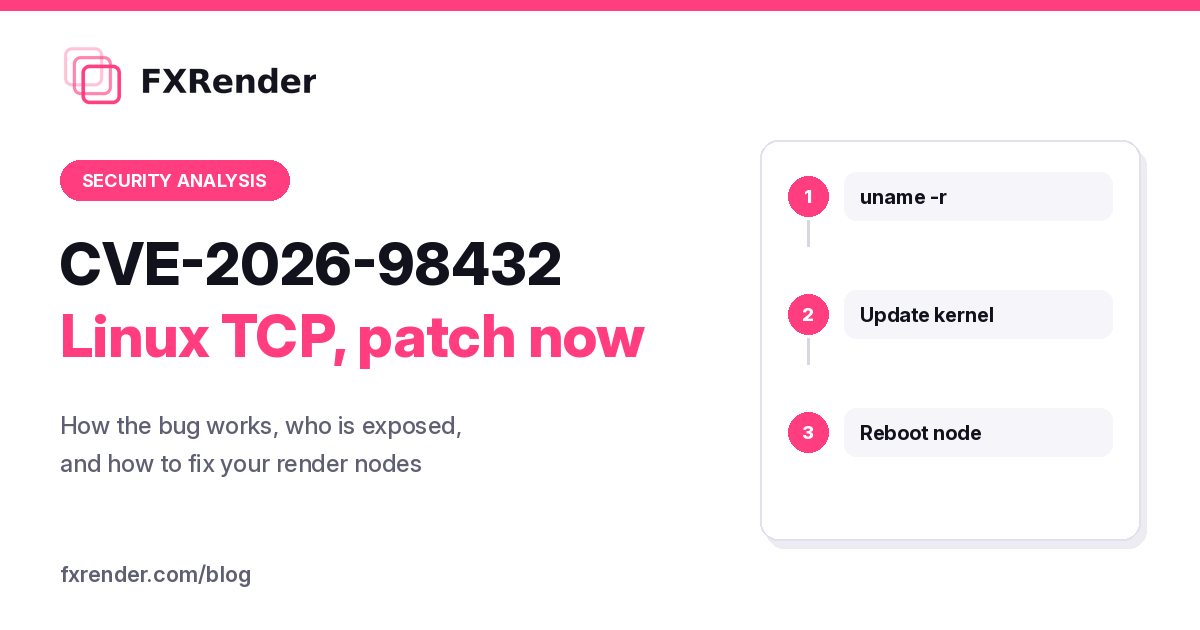
Most security bugs need something from you first: a login, a click, an exposed admin panel. CVE-2026-98432 does not. It is a use-after-free in the Linux kernel's IPv4 TCP handshake code, and the attacker only needs to reach a listening TCP port. The Linux kernel CVE team rates it 9.8 Critical (CVSS 3.1), the flaw has been in the kernel since Linux 4.4, and a researcher has shown it turned into a remote root shell.
The story is still moving. On November 19, 2026 Ubuntu shipped fixes for its older ESM releases in USN-9170-1, and public proof-of-concept repositories keep appearing. If you run Linux render nodes, a render manager, a NAS, or any GPU box that accepts network connections, this is the kernel update to schedule now. This guide explains what the bug is, who is really exposed, how to check a machine in under a minute, and the fixed versions for the main distributions.
What CVE-2026-98432 is, in plain terms
When a client opens a TCP connection, it sends a SYN packet. The kernel keeps a small "request socket" for the half-open connection and answers with a SYNACK. IPv4 packets can carry optional header fields, such as Record Route or Timestamp. If the SYN carries them, the kernel stores those options and uses them to build its reply.
According to the official kernel CVE announcement, when the handshake completes, tcp_v4_syn_recv_sock() hands those stored options to the new child socket without copying them. At the same moment, another CPU can be handling a retransmitted SYN for the same connection and building a fresh SYNACK from the same options, protected only by RCU (read-copy-update). Since an older change let request sockets be processed without holding the listener lock, nothing stops the child socket from being freed while that SYNACK is still being built. The child frees the options with a plain kfree(), and ip_options_build() then reads freed memory.
A second variant exists when request socket migration is enabled (net.ipv4.tcp_migrate_req=1 or a BPF_SK_REUSEPORT_SELECT_OR_MIGRATE program). The fix, as Akamai's technical breakdown shows, is small: both destructors switch from kfree() to kfree_rcu(), which waits until every RCU reader is done before freeing the memory. The CVE text notes that IPv6 is not affected by the main path, because the IPv6 code copies the options.
Why a race condition became a remote root exploit
Races are usually hard to exploit, so why the 9.8 score? Two reasons stand out in the sources.
- Losing the race costs nothing. Anthropic's research post, which disclosed the exploit on October 27, 2026, explains that a lost race only fails the handshake without crashing the system, so an attacker can simply retry. In their proof of concept it took 48 minutes to leak a kernel pointer and another five minutes to reach shell command execution as root.
- No credentials, no user interaction. The attacker needs network access to an IPv4 TCP listener on an unpatched kernel, plus a connection request with IPv4 options followed by a retransmission, per Akamai.
Anthropic says the bug was found and exploited by an unreleased internal research model, and that it has not published its exploit. Akamai and AWS both said they had no evidence of the flaw being used in attacks at the time of their bulletins. But "no public working exploit" is no longer a safe assumption: PoC Index lists 20 public repositories for this CVE, with one pushed as recently as November 19. Many will be checkers or partial proofs, and some may be junk, but the direction is clear.
The MPTCP and Go detail that most coverage gets wrong
Anthropic's demonstrated exploit targets servers with a Multipath TCP (MPTCP) listener. That led to a lot of "just disable MPTCP" advice. Every primary source pushes back on it:
- The Go Security Team says the underlying bug "is not specific to MPTCP" and that systems with no MPTCP listeners may be vulnerable to similar attacks.
- Red Hat's bulletin RHSB-2026-016 states that RHEL, which disables MPTCP by default, is still vulnerable, and that disabling MPTCP "is not a complete mitigation".
- Canonical, as reported by The Hacker News, said security updates are the only appropriate mitigation.
The Go detail matters for pipelines. As of Go 1.24, Go programs enable MPTCP by default on Linux listen sockets. Render pipelines are full of Go services: Blender's own render manager Flamenco is written in Go, and so are many monitoring agents, exporters and internal tools. If a listener was built with Go 1.24 or newer, it may be the exact kind of target the public research describes. The Go team's interim switch is GODEBUG=multipathtcp=0 in the program's environment, or godebug multipathtcp=0 in the main module's go.mod, but they call this "a fragile mitigation" and recommend a patched kernel.
Why render farms and GPU workstations are in scope
A render pipeline has more TCP listeners than people expect. A typical small studio setup includes:
- A render manager (Flamenco, Deadline, or a custom queue) that workers and artists connect to.
- Workers on rented cloud GPUs, often with SSH open to the internet so jobs can be pushed.
- Shared storage (NFS, SMB, a NAS) serving textures and caches over TCP.
- Monitoring such as node exporters and Grafana agents on every machine.
Every one of those is an IPv4 TCP listener, and the bug lives in the kernel, not in the application. It does not matter how well Blender, SSH or your render manager is configured. Rented GPU instances deserve extra attention: you usually manage their kernel yourself, and long-running render boxes are exactly the machines people avoid rebooting mid-project. AWS's bulletin is explicit that customers running self-managed Linux on EC2 are responsible for updating the kernel.
How to check a machine in under a minute
Start with the running kernel. A kernel package sitting on disk does not protect you until you reboot into it.
uname -rCompare the output with the fixed versions below. On Ubuntu, Canonical also suggests listing installed kernel images:
dpkg -l 'linux-image*' | grep ^iiTo see whether anything is listening with MPTCP right now, and whether MPTCP is enabled at all:
ss -Mltn
sysctl net.mptcp.enabled
And check whether request socket migration (the second variant) is switched on:
sysctl net.ipv4.tcp_migrate_reqThese last checks tell you how close a machine is to the demonstrated exploit. They do not tell you it is safe. Only the kernel version does that.
Fixed versions by distribution
Upstream stable kernels. Per Akamai, vulnerable ranges on maintained branches end at 5.10.271, 5.15.222, 6.1.189, 6.6.158, 6.12.112, 6.18.55 and 7.2.9, so the first fixed releases are 5.10.272, 5.15.223, 6.1.190, 6.6.159, 6.12.113, 6.18.56 and 7.2.10. Kernels from 4.4 onward on branches that no longer get stable updates stay vulnerable.
Ubuntu. Canonical's advisory (updated November 9) lists the fixes in the regular archive:
| Release | Fixed kernel |
|---|---|
| 22.04 LTS (Jammy) | 5.15.0-203.213 |
| 24.04 LTS (Noble) | 6.8.0-149.149 |
| 26.04 LTS (Resolute) | 7.0.0-43.43 |
| 26.10 | 7.3.0-10.10 |
Ubuntu 20.04 and 18.04 got fixes through Ubuntu Pro in USN-9170-1 on November 19, 2026, which includes cloud kernel flavors such as linux-aws and linux-gcp. Apply with sudo apt update && sudo apt upgrade, then sudo reboot.
RHEL. Red Hat shipped fixed kernels for RHEL 8, 9 and 10 on November 1. As reported by The Hacker News, these are 4.18.0-553.182.1.el8_10 (RHEL 8.10), 5.14.0-687.64.1.el9_8 (RHEL 9.8) and 6.12.0-211.72.1.el10_2 (RHEL 10.2). Check RHSB-2026-016 for layered products such as OpenShift.
Amazon Linux. AWS lists fixed kernel packages for Amazon Linux 2 and Amazon Linux 2023. Update the kernel package and reboot; AL2023 instances locked to a release version need release 2023.12.20261102 or later.
If you cannot reboot today
Red Hat published an interim nftables rule that drops inbound IPv4 TCP packets carrying IP options, which blocks the known trigger:
table inet cve_2026_98432 {
    chain input {
        type filter hook input priority -310; policy accept;
        ip protocol tcp ip hdrlength > 5 counter drop
    }
}
Treat it as a bridge, not a fix. Red Hat says filtering may disrupt workloads that rely on IPv4 options and is not a substitute for patching, and a kernel engineer noted on oss-security (as reported by The Hacker News) that the filter only applies to the host where it is loaded, so traffic between containers on the same host can bypass it. A practical plan for a render farm:
- Put the filter on every node today, and set
GODEBUG=multipathtcp=0for Go services you control. - Close ports you do not need. Workers rarely need to accept inbound connections from the internet.
- Drain nodes one at a time between jobs, update the kernel, reboot, and confirm with
uname -r. - Patch the manager and storage hosts last only if they are not internet facing; otherwise patch them first.
What this bug says about pipeline security in 2026
The interesting part is not the code, which is a two-line fix. It is the timeline. The fix landed upstream on October 5, the CVE was published on October 15, a working remote root chain was described on October 27, and public PoC repositories followed within days. Anthropic's post frames it as frontier models making multi-step exploit development something that "models can do with little human involvement". Whatever you think of that claim, the window between a quiet kernel commit and a usable exploit is shrinking, and the boxes that sit unpatched longest are the ones nobody wants to reboot: render nodes in the middle of a deadline.
Fewer boxes to patch with a managed render farm
Every self-managed render node is another kernel you have to track, patch and reboot. If you render Blender projects, FXRender is a cloud GPU render farm where GPU rendering is $1.50 per hour, jobs can be automated through a CLI and MCP, and you get the full per-frame render log for every job. Moving burst rendering to a managed farm means fewer internet-facing GPU machines of your own to keep current.
FAQ
What is CVE-2026-98432?
CVE-2026-98432 is a use-after-free race in the Linux kernel IPv4 TCP handshake code. IP options attached to an incoming connection can be freed while another CPU is still using them to build a SYNACK. It is rated 9.8 Critical and can be reached by a remote attacker without credentials.
Which Linux kernels are affected?
Kernels from Linux 4.4 onward without the fix. On upstream stable branches the first fixed versions are 5.10.272, 5.15.223, 6.1.190, 6.6.159, 6.12.113, 6.18.56 and 7.2.10. Distribution kernels have their own fixed package versions.
Is disabling MPTCP enough to protect a server?
No. The demonstrated exploit uses an MPTCP listener, but the Go Security Team, Red Hat and Canonical all say the bug is in the IPv4 TCP path and that a patched kernel is the real fix. RHEL disables MPTCP by default and is still listed as vulnerable.
How do I check if my Linux server is patched?
Run uname -r to see the running kernel and compare it with your distribution fixed version. A newer kernel installed on disk does not protect you until you reboot into it.
Is there a public exploit for CVE-2026-98432?
Anthropic described a working remote root exploit but has not released it. PoC Index lists 20 public repositories for the CVE as of November 2026, ranging from checkers to partial proofs, so you should treat exploitation as realistic.
Does IPv6 traffic trigger the bug?
According to the kernel CVE description, IPv6 is not affected by the main path because the IPv6 code copies the options. A related migration issue in IPv6 is to be addressed separately, and almost every server also listens on IPv4, so patching is still required.
Sources: Linux kernel CVE announcement, Akamai, Anthropic, Go Security Team via oss-security, Red Hat RHSB-2026-016, Canonical, USN-9170-1, AWS bulletin 2026-160-AWS, The Hacker News, PoC Index.