CVE-2026-123890 Explained: The vCenter Zero-Day Behind VMSA-2026-0009
CVE-2026-123890 is a 9.8 Critical vCenter authentication bypass that a China-nexus group exploited as a zero-day in September 2026. Here is how the SRP session key leak works, which builds fix it, and how studios running render VMs on vSphere should patch and harden.
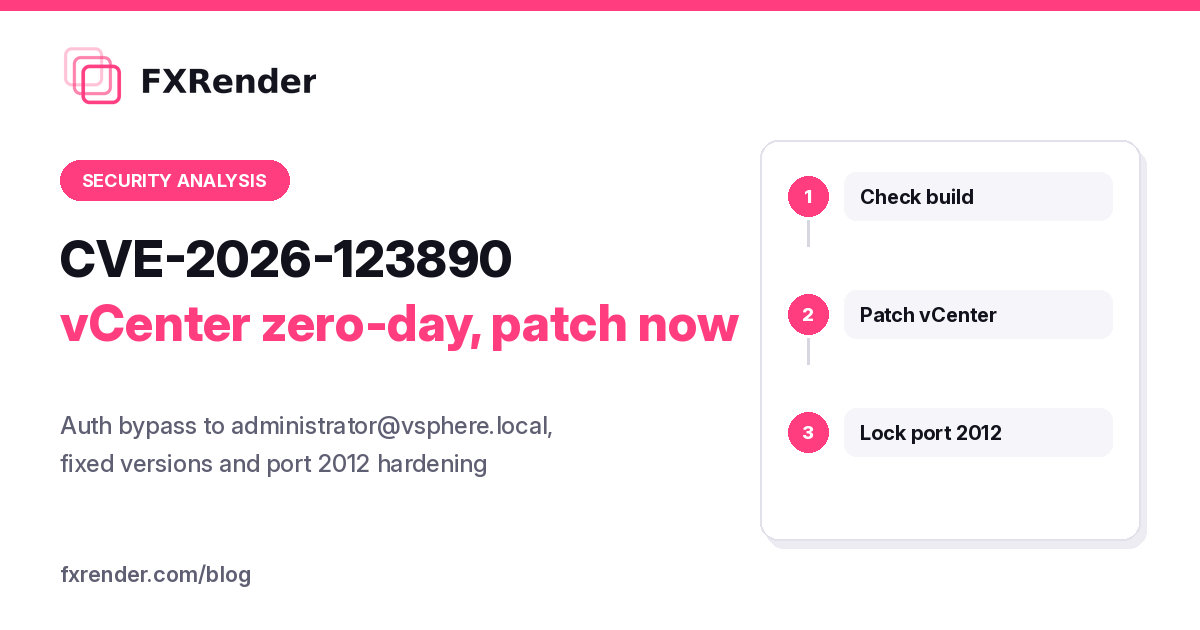
On 19 November 2026 Broadcom published VMSA-2026-0009, a Critical advisory for VMware vCenter, SDDC Manager and VMware Tools. The headline bug, CVE-2026-123890, lets anyone who can reach vCenter over the network skip authentication and act as the built-in administrator. It is not a theoretical problem: Google Threat Intelligence Group (GTIG) and Mandiant published an analysis showing a suspected China-nexus group had used it as a zero-day in early September.
This post explains how the flaw works, which builds fix it, how to check your own vCenter, and what extra hardening is worth doing. It is written for infrastructure people, including the many animation, VFX and visualization studios that run render nodes, artist VDI and license servers as virtual machines on vSphere.
CVE-2026-123890 at a glance
- Product: VMware vCenter (VMware Directory Service,
vmdird), including vCenter inside VMware Cloud Foundation, vSphere Foundation, Telco Cloud Platform and Telco Cloud Infrastructure. - Severity: Critical, CVSSv3 9.8, per Broadcom. Rapid7 classifies it as CWE-288, authentication bypass using an alternate path or channel (Rapid7).
- Attack requirement: network access to vCenter. No credentials, no user interaction.
- Exploited in the wild: yes, by the actor GTIG tracks as ARMORY CASTLE, as early as September 2026.
- Workaround: none listed by Broadcom.
- Reported by: Mandiant.
How the vCenter authentication bypass works
vCenter Single Sign-On is backed by the VMware Directory Service, an LDAP-style directory that stores identities, the Security Token Service (STS) configuration and the keys used to sign SAML tokens. Besides LDAP it exposes DCE/RPC interfaces, and one of them handles Secure Remote Password (SRP-6a) authentication.
According to GTIG, CVE-2026-123890 is an unauthenticated SRP-6a session key disclosure over DCE/RPC. A flaw in the rpc_srp_verifier service on TCP port 2012 exposes the shared session key that is supposed to be the secret result of the SRP exchange. With that key an attacker can create an authenticated session as [email protected] without ever knowing the password. GTIG notes that port 2012 is the control interface RPC for vCenter SSO.
From there the attacker is effectively the root of the vSphere identity system. GTIG documents what the actor's Go-based exploitation tool, which it names BONESAW, did with that session:
- streamed the raw directory database (
data.mdb, an LMDB file) out for offline parsing; - extracted the STS SAML private RSA signing key;
- created a backdoor machine account in
vmdirand an SSO administrator account; - forged administrative SAML 2.0 assertions and granted Global Administrator on the vCenter root folder through the vSphere SOAP API.
The signing key theft matters most for cleanup. Anyone holding that key can mint valid SAML tokens, so patching alone does not evict an attacker who already took it. That is our inference from how SAML signing works, not a Broadcom statement.
What the real attack looked like
The GTIG write-up is useful because it shows the path, not just the bug. ARMORY CASTLE first came in through a separate zero-day in BeyondTrust Remote Support (CVE-2026-102764, covered in an earlier GTIG post), then moved to internal Linux appliances that had no EDR. They dropped two small JSP webshells, escalated to root by setting SUID on /bin/env with gdb, and scanned the internal network for VMware ports with nmap. The scans targeted 443, 389, 2012, 5480 and 9080, and GTIG calls out 2012 as integral to the exploit.
Two lessons stand out. First, the attacker did not need vCenter to be on the internet. A foothold on any internal box that could reach vCenter was enough. Second, the entry point was an unmonitored appliance, the kind of license server or old render manager VM many studios keep on a flat network.
Affected and fixed versions
The table below is copied from the response matrix in VMSA-2026-0009. Patches are cumulative, so any later build of the same branch is also fixed.
| Product | Branch | Fixed version |
|---|---|---|
| vCenter (VCF / vSphere Foundation) | 9.1.x | 9.1.1.0200 |
| vCenter (VCF / vSphere Foundation) | 9.0.x | 9.0.2.0200 |
| vCenter | 8.0 | 8.0 U3m |
| vCenter | 7.0 | Contact Broadcom Support (extended support contracts) |
| VMware Cloud Foundation | 5.x | 5.2.5 (apply vCenter 8.0 U3m via KB 88287) |
| Telco Cloud Platform / Infrastructure | various | KB463116 |
Broadcom's supplemental FAQ adds several details worth knowing before you start:
- ESX is not affected. You do not need to touch hypervisor hosts for this advisory.
- Enhanced Linked Mode is irrelevant. The bug is in vCenter itself, so standalone vCenters are just as exposed.
- vSphere 6.5 and 6.7 should be presumed vulnerable. Broadcom does not evaluate end-of-support versions.
- No vCenter Quick Patch. These updates are not eligible for the VCF 9.1 Quick Patch path; use the normal update method, including the VAMI.
- Back-in-Time restriction. vCenter 8.0 U3m and 9.0.2.0200 block upgrades to VCF 9.1.1 until VCF 9.1.2 ships. If you are mid-upgrade, read question 39 of the FAQ first.
- It is a different bug from CVE-2026-59309. That earlier vCenter authentication bypass, fixed in VMSA-2026-0006 in July, does not protect you here.
The other four CVEs in VMSA-2026-0009
The same advisory fixes four lower-rated issues. All need an authenticated or already privileged attacker, so they are secondary to CVE-2026-123890, but they belong in the same change window:
- CVE-2026-123891 (8.1): SQL injection in SDDC Manager.
- CVE-2026-123892 (7.2): authenticated command injection in SDDC Manager.
- CVE-2026-123893 (6.7): privilege escalation to root on SDDC Manager for an existing administrator.
- CVE-2026-123894 (6.7): SAML token signature bypass in VMware Tools for Windows, exploitable only on guests configured with guest alias mapping, and contained inside the guest. Fixed in VMware Tools 13.1.5.0 and 12.5.5 (12.4.10 for 32-bit Windows).
Broadcom is explicit that none of these is a VM escape.
How to check if your vCenter is vulnerable
The quickest check is the vSphere Client: the build and version appear on the vCenter Summary tab. With PowerCLI, the FAQ suggests:
Connect-VIServer vcenter.example.local
$global:DefaultVIServer.Version
$global:DefaultVIServer.Build
Compare the result with the table above. If you run Windows render or workstation VMs, list their VMware Tools versions in the same session:
Get-VM | Where-Object { $_.Guest.OSFullName -like "*Windows*" } |
  Select-Object Name,@{N="ToolsVersion";E={$_.Guest.ToolsVersion}}
Then check reachability. From a machine that should not be able to manage vCenter, such as a render node or an artist workstation, test whether TCP 2012 answers:
nc -zv vcenter.example.local 2012If it connects, that host could have been used as a launch point in exactly the way GTIG describes. Broadcom's Ports and Protocols tool lists what vCenter legitimately needs, which helps when you write allow rules.
Patching without stopping your renders
A common worry in studios is that touching vCenter mid-deadline will kill running frames. The FAQ answers this directly: during a vCenter update the vSphere Client and other management interfaces are unavailable for a short time, but virtual machine and container workloads keep running. vSphere HA and vSAN keep working too; only operations such as new encryption or key rotation against a Standard Key Provider wait until vCenter is back.
So a practical order is:
- Take a file-based backup or snapshot of the vCenter appliance according to your normal procedure.
- Confirm the target build supports your ESX versions in the Interoperability Matrix.
- Update vCenter through the VAMI or your usual lifecycle tool. Render VMs continue; render managers that talk to the vSphere API may lose that connection briefly, so pause any automation that spins VMs up or down.
- Update VMware Tools on Windows guests during your next normal maintenance window.
- If you run VCF, update SDDC Manager to the fixed version for your branch.
Hardening beyond the patch
GTIG's main argument is that vCenter is a control plane and should not depend on patches alone. Its recommendations, adapted for a typical studio network:
- Put vCenter on a management network. Render nodes, artist machines and general servers should not reach TCP 2012, 5480, 22 or even 443 on vCenter. Only admin jump hosts and the specific services that need the API, such as backup, should.
- Do not trust the VAMI firewall alone. GTIG points out it lacks per-port granularity, can be switched off by anyone who reaches the VAMI, does not log denied connections and ignores egress. Mandiant recommends enforcing default-deny
iptablesrules at the appliance level with its VCSA hardening tool, after proper testing and change control. - Filter egress from vCenter. In the observed intrusion, a backdoor used Slack APIs for command and control. vCenter has very few legitimate reasons to talk to the internet.
- Forward appliance logs to a SIEM. Shell commands, dropped connections and SSH enablement through the VAMI API are all early signals.
- Watch the boring boxes. The pivot came from internal Linux appliances without EDR. Inventory every appliance and VM that can reach management networks.
If you find signs of compromise, such as unexpected SSO administrators or machine accounts, assume the SAML signing material may be exposed and work with your incident response provider, using the indicators and YARA rules in the GTIG post.
Why render pipelines should care
Studios often virtualize everything around rendering: the render manager, license servers, asset databases, Windows workstations for remote artists, and sometimes the render nodes themselves. vCenter controls all of it. An attacker with administrator on vCenter can clone a VM that holds client footage, power off a farm during delivery, or read a disk image offline. For studios under client security requirements, an unpatched vCenter with a known exploited bug is also a compliance problem, not just a technical one.
The good news: ESX is untouched and workloads keep running while you patch.
Where FXRender fits
If part of the reason you run vSphere is to host burst Blender render capacity, a managed farm takes that control plane off your list. FXRender is a cloud GPU render farm for Blender at $1.50 per GPU-hour, with CLI and MCP automation and full per-frame render logs. It does not replace your studio infrastructure, but it is one fewer hypervisor stack to patch on a Friday.
FAQ
What is CVE-2026-123890?
CVE-2026-123890 is an authentication bypass in the VMware Directory Service inside vCenter. Broadcom rates it Critical with a CVSSv3 score of 9.8. Google Threat Intelligence Group describes it as an unauthenticated SRP-6a session key disclosure over DCE/RPC that gives an attacker an authenticated session as [email protected].
Is CVE-2026-123890 being exploited?
Yes. Google Threat Intelligence Group and Mandiant report that the suspected China-nexus actor ARMORY CASTLE exploited it as a zero-day in early September 2026, more than two months before Broadcom published VMSA-2026-0009 on 19 November 2026.
Which vCenter versions fix CVE-2026-123890?
Per VMSA-2026-0009: vCenter 9.1.1.0200 for 9.1.x, 9.0.2.0200 for 9.0.x, 8.0 U3m for 8.0, and 5.2.5 for VMware Cloud Foundation 5.x via the asynchronous patching process in KB 88287. vCenter 7.0 customers with extended support must contact Broadcom Support. Telco Cloud Platform and Telco Cloud Infrastructure follow KB463116.
Is there a workaround for CVE-2026-123890?
Broadcom lists no workaround. Restricting network access to vCenter, especially TCP 2012, reduces exposure, but the only fix is installing a patched build.
Do I need to patch ESX hosts for VMSA-2026-0009?
No. Broadcom states ESX is not affected by this advisory. You need to update vCenter, SDDC Manager if you run VMware Cloud Foundation, and VMware Tools in Windows virtual machines.
Will patching vCenter stop my running virtual machines or render jobs?
No. Broadcom says the vSphere Client and other management paths are briefly unavailable during the vCenter update, but virtual machine and container workloads keep running.
Is CVE-2026-123890 the same as CVE-2026-59309?
No. Broadcom says CVE-2026-123890 is a new and distinct issue from the CVE-2026-59309 authentication bypass fixed in VMSA-2026-0006 in July 2026, so systems patched for the earlier bug still need this update.