Nginx HTTP/2 Vulnerabilities: CVE-2026-123007 and CVE-2026-123633
On 18 November 2026, nginx published fixes for two HTTP/2 memory-safety flaws, CVE-2026-123007 and CVE-2026-123633. Researchers say both can lead to unauthenticated code execution. Here is who is affected and how to check, patch, or temporarily mitigate.
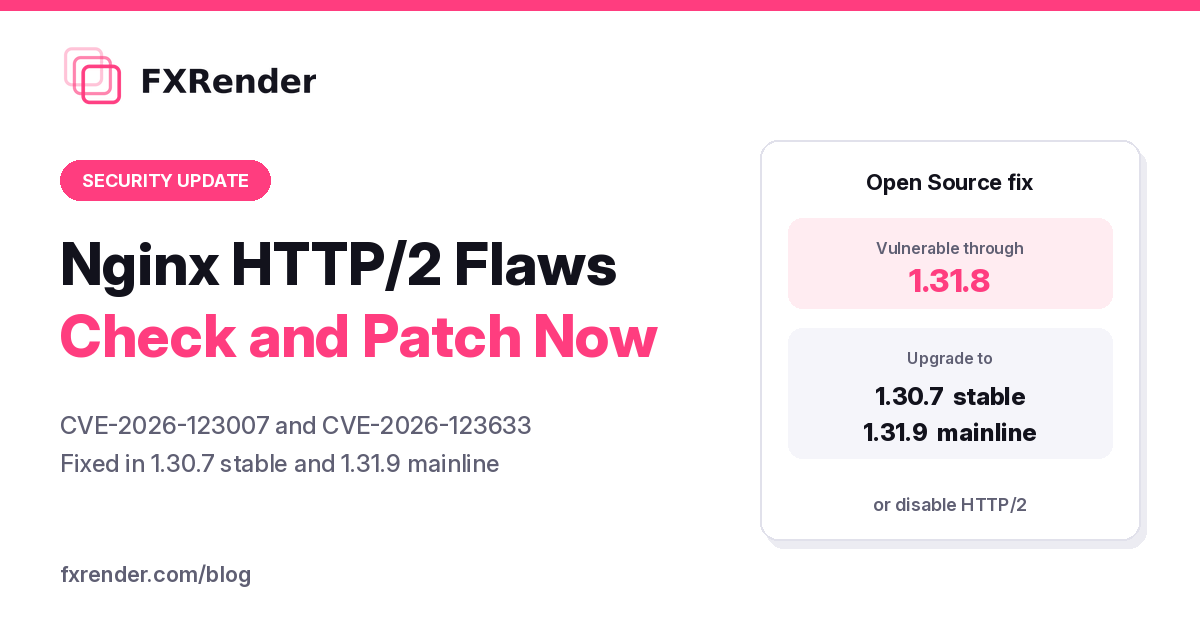
On 18 November 2026 the nginx project released nginx 1.30.7 (stable) and nginx 1.31.9 (mainline) with fixes for several security issues. Two of them are HTTP/2 memory-safety flaws: CVE-2026-123007 and CVE-2026-123633. Wiz Research, along with Ikotas Labs, Metnir, Rapid7, and Xint, say both can lead to unauthenticated remote code execution.
The flaws sit in nginx itself, not in your application code. If a render farm or studio puts nginx in front of a dashboard or API with HTTP/2 enabled, that front end should be checked and patched like any other internet-facing nginx instance. Official nginx advisories are the source of record below; Wiz claims are labeled where the vendor wording is more cautious.
What happened
nginx published the fixes on 18 November 2026, the same day Wiz published its write-up and F5 issued product advisories. According to Wiz, the use-after-free was reported to F5 on 21 October 2026, and the second flaw on 16 November 2026.
CVE-2026-123007 is listed on the official nginx advisories page as "Memory corruption in HTTP/2 flow control," with severity major. The changelogs say a flow-control window overflow might crash a worker process, or might have "potential other impact." The CVE description republished by Debian and Amazon Linux adds that the window can exceed its limit, causing a heap buffer overflow and a worker crash, and that code execution is possible if address-space layout randomization (ASLR) is disabled or bypassed. Wiz rates the issue Critical with a CVSS 4.0 score of 9.2, and says it demonstrated remote code execution, including on nginx serving static files over HTTPS on 64-bit systems. Red Hat and Amazon Linux list a CVSS 3.1 score of 8.1.
CVE-2026-123633 is listed by nginx as "Use-after-free in HTTP/2," with severity medium. The changelog says a use-after-free might occur when using HTTP/2 if worker_connections were not enough. The vendor text republished by Amazon Linux says this applies when nginx accepts HTTP/2 client connections, proxies them to a backend, and the worker is low on worker_connections. Wiz also rates it Critical (CVSS 4.0 9.2) as a reverse-proxy issue when connection slots run low. Red Hat scores it 8.1 on the CVSS 3.1 scale.
Both flaws require HTTP/2 to be enabled, which every official source agrees on. CVE-2026-123007 does not need a backend application. CVE-2026-123633 does, plus the low worker_connections condition. If exploitation succeeds, it would run as the nginx worker, not automatically as root. That is still serious: a worker can hold TLS material, see traffic, and reach internal services it proxies.
The same 18 November releases also fix other issues, including an HTTP/3 use-after-free (CVE-2026-121810) Upgrading also picks up those other fixes.
Who is affected
According to nginx.org, the affected and fixed Open Source ranges are:
| CVE | Official nginx summary | nginx severity | Vulnerable versions | Not vulnerable |
|---|---|---|---|---|
| CVE-2026-123007 | Memory corruption in HTTP/2 flow control | major | 1.9.5 through 1.31.8 | 1.30.7+, 1.31.9+ |
| CVE-2026-123633 | Use-after-free in HTTP/2 | medium | 1.19.7 through 1.31.8 | 1.30.7+, 1.31.9+ |
Builds in those ranges are only exposed if HTTP/2 is enabled on a listening port. Many default package configs leave HTTP/2 off; many production HTTPS configs turn it on with listen ... http2; or, on 1.25.1 and later, http2 on;.
NGINX Plus is also in scope. Wiz, CERT-EU, and the Canadian Centre for Cyber Security summary of the F5 advisory all say Plus is affected on recent branches, including R33 through R36 and early 37.x releases. Wiz lists fixed Plus builds as 37.0.7.1 and 37.2.0.1 for CVE-2026-123633, and 37.0.8.1 and 37.3.0.1 for CVE-2026-123007. Confirm the exact build against F5's advisories K000163926, K000163928, and K000164058.
Containers, ingress controllers, and images that embed nginx need the same check. Do not assume a front-end proxy or CDN already protects the origin; Wiz says terminating HTTP/2 there can help, depending on the implementation.
How to check your version
On the host or container that runs nginx:
nginx -vThen confirm whether HTTP/2 is enabled in the running config:
nginx -T 2>/dev/null | grep -E 'listen|http2'If nginx -T is restricted, search the config tree, usually under /etc/nginx:
grep -R --line-number -E 'listen|http2' /etc/nginxLook for an http2 parameter on a listen directive, or http2 on;. Confirm the binary was built with HTTP/2 support:
nginx -V 2>&1 | tr ' ' '
' | grep -i http_v2
A package older than 1.30.7 or 1.31.9 is not automatically unpatched. Distributions often backport fixes into their own version numbers, so compare what you have against your distro's security notice, not only against the upstream version.
How to patch
Run a release that nginx lists as not vulnerable: 1.30.7 or later on the stable branch, or 1.31.9 or later on mainline. Official packages are on nginx.org's Linux packages page. After installing the update, restart nginx fully so old workers are replaced; a reload is not enough.
Quick Steps for Ubuntu:
sudo apt update
sudo apt install -y curl gnupg2 ca-certificates lsb-release ubuntu-keyring
sudo cp -a /etc/nginx /etc/nginx.backup.$(date +%F)
curl -fsSL https://nginx.org/keys/nginx_signing.key | gpg --dearmor | sudo tee /usr/share/keyrings/nginx-archive-keyring.gpg >/dev/null
sudo apt updatesudo apt install -y curl gnupg2 ca-certificates lsb-release ubuntu-keyring
echo "deb [signed-by=/usr/share/keyrings/nginx-archive-keyring.gpg] http://nginx.org/packages/mainline/ubuntu $(lsb_release -cs) nginx" | sudo tee /etc/apt/sources.list.d/nginx.list
printf "Package: *\nPin: origin nginx.org\nPin: release o=nginx\nPin-Priority: 900\n" | sudo tee /etc/apt/preferences.d/99nginx
sudo apt update
sudo apt install -y nginx #(opt for default option when prompt to rewrite nginx.conf)
sudo nginx -t
sudo nginx restart
If you install from a distribution repository, use the vendor advisory. Package status as of 19 November 2026 (Asia/Calcutta):
- Ubuntu: USN-9159-1, published 19 November 2026, includes nginx 1.24.0-2ubuntu7.20 on 24.04 LTS, 1.18.0-6ubuntu14.23 on 22.04 LTS, 1.28.3-2ubuntu1.13 on 26.04 LTS, and 1.30.4-7ubuntu1.2 on 26.10. Older releases are covered through Ubuntu Pro in the same notice.
- Amazon Linux 2023: ALAS2023-2026-3494 ships nginx 1.30.7-1.amzn2023.0.1. A fix is also listed for the Amazon Linux 2 nginx1 extra repository.
- Alpine Linux: the Alpine tracker marks nginx 1.30.7-r0 as fixed on 3.24 and edge, and 1.28.3-r8 as a backport on 3.22 and 3.23.
- Debian: the security tracker still listed bookworm and trixie as vulnerable. Unstable (sid) package 1.30.6-4 was marked fixed as a backport. Until a stable security update appears, use nginx.org packages or disable HTTP/2.
- Red Hat Enterprise Linux 8, 9, and 10: RHSB-2026-019 said Red Hat was expediting fixes and had not yet listed released errata. Until those packages appear, Red Hat recommends disabling HTTP/2.
For NGINX Plus, apply the F5 updates published with the 18 November 2026 advisories, then restart. Confirm the exact build in the F5 K articles above.
Temporary mitigations
If you cannot upgrade immediately, disable HTTP/2 on exposed listeners. Remove the http2 parameter from listen directives. On nginx 1.25.1 and later, also set http2 off; in the affected server blocks, as Wiz and Red Hat recommend. Test that clients still reach the site over HTTP/1.1, reload nginx, and confirm the old workers have exited. Turn HTTP/2 back on after you upgrade. This does not replace a full upgrade, which also covers other bugs in the same 18 November releases.
CERT-EU also suggests watching the error log for worker process crashes (worker process ... exited on signal). That can be a sign of a crash or an exploitation attempt, not proof of a successful compromise. As of CERT-EU's 18 November 2026 advisory, no exploitation in the wild had been reported. Treat internet-facing servers as urgent anyway.
FAQ
Which nginx versions are affected by CVE-2026-123007 and CVE-2026-123633?
nginx.org lists CVE-2026-123007 as affecting 1.9.5 through 1.31.8, and CVE-2026-123633 as affecting 1.19.7 through 1.31.8. Both require HTTP/2. The fixed Open Source releases are 1.30.7 (stable) and 1.31.9 (mainline), or a distro package that has backported the same fixes.
How do I check if nginx HTTP/2 is enabled?
Run nginx -v, then inspect the running config with nginx -T, or search /etc/nginx, for an http2 parameter on a listen directive or an http2 on; setting. nginx -V shows whether the binary was built with HTTP/2 support.
What nginx version fixes these HTTP/2 vulnerabilities?
The official nginx advisories mark 1.30.7 and later on the stable branch, and 1.31.9 and later on mainline, as not vulnerable. For distribution packages, use the vendor security notice, because the package version may stay on an older upstream number after a backport. NGINX Plus users should apply the F5 builds listed in the 18 November 2026 advisories.
Is disabling HTTP/2 enough if I cannot patch yet?
Yes, as a temporary mitigation. Remove the http2 parameter from listen directives, and on nginx 1.25.1 or later also set http2 off;. Test that clients still work over HTTP/1.1, reload nginx, and confirm old workers have exited. Re-enable HTTP/2 after you upgrade. This does not fix other issues in the same 18 November releases.
Do render farm or studio nginx dashboards need this patch?
Yes, if those dashboards, APIs, or asset portals are served by an affected nginx version with HTTP/2 enabled. Check the version, confirm whether HTTP/2 is on, and upgrade or temporarily disable HTTP/2.